Traditional Thai painting could distinctively and particularly reflect the existence of Thai culture. It has been inherited for generations as well as for centuries. However, there is little evidence of transforming on the aspect of both content and presentation.
The reason why traditional painting masters in the past paid little attention to develop the way of artistic presentation in their art works to carry more individualistic identity was from the basic way of thinking in those years. The artists devote their art works to royal and religious institutes. So the art works in the past were the mater of paying tribute to those patronizing the artists, not the matter of individualistic expression like today.
The process of changing started when the Imperialism force by the Western countries evaded the region. Even though the Siam Kingdom did not lose sovereignty, it faced not much different fate from other neighbouring countries. Finally, the kingdom had to open for Western civilization, adopting once strange culture to be part of daily life, and inseparable part of life like today.
Such floods of Western civilization in almost every inch of Thai society more or less shake and changed way of thinking of Thai people.
Such phenomenon decreased the significance of both royal and religious institutes as key supporters to traditional Thai paintings. Later came the emergence of the role of private and business sectors.
Meanwhile, high-class people of Thai society tended to more appreciate Western style art, importing European painters to produce modern art works to serve increasing demand.
The traditional Thai painting society, which was static in terms of developing for centuries, gradually became less popular and disregarded by modern generations.
While traditional spirit from the old days became faded away, Thai art buffs tremendously focused their interest on Western style art. Many modern fine art style paraded to dominate Thai art scene, such as Realism, Romanticism and Impressionism.
However, on the little corner, some young artists still pursue following the footsteps of traditional painters, keeping one of national heritage not to disappear.
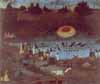
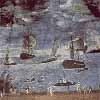
One of early evidence on modernizing traditional Thai painting was groups of works by Krua In Kong, leading painter during the period of King Rama III. This senior novice-cum-painter applied western painting techniques to be mingled with traditional presentation.
Krua In Kong's works escape the conventional techniques of producing lining-accented drawing composed of many refined visual patterns. His mural paintings were full of perspective and chiaroscuro elements, resulting more realistic visualization.
However, Unfortunately, no painting artist could carry such innovative artistic creation similar to Krua In Kong for decades. It was not until Prof Corado Feroci, having changed his name to be Silpa Bhirasri later, came to concretely lay the base of modern art academy in Thailand. He involved the founding of Praneet Silapakam art school in 1934, which was transformed to be Silpakorn University later in 1945.
The university played crucial role on paving the way of modernized Thai painting, as more than half of contemporary artists on modified Thai painting are from the institute, such as Chalermchai Kositpipat and Panya Vijinthanasarn.
Both pioneer graduates on Thai Art degree influenced a lot to the next generations; as a result, there is a stream to create modernized Thai paintings actively.
Moreover, there are new content to be presented in modern Thai paintings, such as social and psychological theme, breaking the tradition of catching only stories from Jataka tales and the life of the Lord Buddha.
Early sets of Chalermchai's paintings, made not long after his graduation from Silpakorn University, amazed local art buffs for the possibility to feature traditional style of Thai paintings with modern touch presentation.
With superficial or general viewing, Chalermchai's works made between 1976 to 1979 are not much different from typical conventional Thai paintings in the old days. he keeps conventional techniques of linings, high-angle point of view presentation, slanting lines and two-dimensional-accented visualization.
But, with more profound viewing, his works carry many modern techniques, such as high-contrast, coloring, shading, and the use of unorthodox color scheme.
For the aspect of content, Chalermchai's subjects does not feature typical figures like mythological angel and giants in exquisite costume. Moreover, he does not explore much 'kanok' (Thai decorative) patterns.
Chalermchai's paintings are not like those of Panya Vijinthanasarn. Panya (1956 - ) not only modifies 'kanok' patterns, but also modifies mythological figures, especially on his works made between 1979 to 1984.
Moreover, Panya's works carry content not on typical subjects like stories from the Buddhism literature or Ramayana literature. He prefers to imply current social issues in his paintings, such as the issues on violence, abuse and struggling from social bound.
With such presentation, Panya could create a new boundary of Thai Art, by combining many techniques of various Western art schools with convention of Thai art.
Such innovative combinations are such as surrealistic background and landscape visualization, space exploration, realistic coloring, and creative composition.
Artistic innovation of both Chalermchai and Panya set major footprint for the following generations of Thai style artsits. But nobody else could create works without influences from the two pioneers.
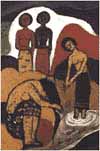
It is not until Prasong Luemaung, a forth year student who walked out from Silpakorn University, came into limelight. He has his own signature without influence of both Chalermchai and Panya. Prasong's works broaden perspective of creating modern Thai art.
It could not be said that Prasong's paintings contain authentic touch of traditional Thai art. Forms and figures in his paintings do not indicate elements of traditional look. No beautiful mythological figures, no ornamental costume, and no elaborated palace appear in Prasong's paintings. Moreover, he does not touch any subjects from the Lord Buddha's life and Buddhism philosophy in his works.
Prasong enjoys depicting the scene of folk layman with simple way of life along peaceful rural villages.
Reflecting his own character, Prasong's paintings are full of gentle but charismatic touch. Although his canvas works seem to contain excessive ornaments, Prasong places scattering figures harmoniously with arranged composition.
This Northern artist properly intermingles ethnic visual elements from various Asian cultures with some Western art forms.
Prasong's cross-culture gimmick inspires and paves way to youngers generations how to create alternative Thai art.
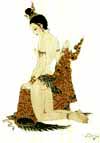
The evolution of modernized Thai art is involved by not only Chalermchai, Panya and Prasong. Many names from earlier period should get credit as well. They are Khien Yimsiri, Angkarn Kalayanapongsa, Chalood Nimsamer, Thawan Dachanee, Chuang Moolpinit and Chakrabhand Posayakrit. All contributed much on opening the scope of modern Thai art to be out of traditional bound.
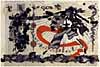
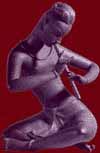
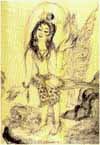
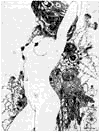
Khien molds distinguished characteristics of Western art with convention of traditional Thai art in his sculptures. Chalood minimizes ornamental elements of Thai art in his prints and paintings. 'Kanok' patterns are greatly modified by two masters; Angkarn on his crayon sketching and Chuang on his still-life drawings of natural creatures and plants.
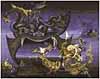
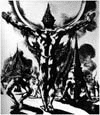
Thawan interprets stories from Buddhism philosophy to reflect human psychology. His drawings are full of grotesque figures of mythological creatures with surrealistic look. Liveliness, brightness and gentle exist in Chakrabhand's modern Thai paintings.
All can successfully escape the labyrinthine presentation of traditional style of Thai art to feature more individualistic and innovative, suitable for contemporary society. At this moment, it can be cited that the modernizing of Thai art has been established, and will be more progressed if new generations are still active and determined like the mentioned senior names.