 |  |  |  |
 |
 |
| Since ancient times, Thai kings have traveled in processions on land or by river, and on significant occasions these have been extremely elaborate. Among the most spectacular of all are the major royal barge processions, which are reserved for river journeys made by the king for private or official functions.
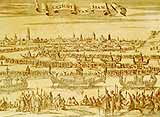
Archeologists and historians believe that the traditions of the Royal Barge Procession has existed since the Sukhothai Period some seven centuries ago. The oldest extant references to it, however, date back only to the Early Ayutthaya Period. Ayutthaya is an island city completely surrounded by rivers and canals. Residents of the city who traditionally have lived on waterways were largely dependent until recent times on boats for transportation and communication. In times of war, naval battles frequently took place, and numerous battle barges were built during the Ayutthaya Period. In the year 1357, King Boromtrailokanat of Ayutthaya decreed that provisions be added to the Palace Law concerning the use of the royal barges. It was specifically stated that during the 11th lunar month a court ceremony called Asayuth was to be held, during which a race was to be held between two of the major barges - Samatthachai, the king's barge, and Kraisonramuk, which was used by the queen. A victory by the queen's barge would signify fertility and abundance, while of the king's barge won, the populace could expect hardship and famine. In the actual events, therefore, the Samatthachai normally yielded to the Kraisonramuk. Article 164 of the Palace Law also specifies that the Jong Priang royal ceremony is to be held in the 12 lunar month with a floating of lights in the waterways under the full moon.
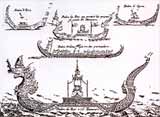
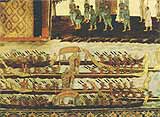
During peacetime, when the tide is at its highest at the end of the rainy season, young men who are free trom work in the ricefields have traditionally been recruited for practice sessions as oarsmen for major ceremonies such as welcoming dignitaries and the presentation of the royal Kathin robes by the king. The ancient battle formation presents an impressive display of royal majesty and authority, while also providing enjoyment for the people, who gather to watch it from the riverbanks. The barges are elaborately carved and decorated in accordance with the categories and classes. During the reign of King Narai the Great of Ayutthata during the 17 century, the king made several river journeys in royal barge processions arranged in the four-line Phet Phuang configuration. The royal barge was at the center of a formation that consisted of more than 100 other barges. An account by a French envoy to the court of King Narai, Nicholas Gervaise, describes the stunning spectacle of a major royal barge procession of over 200 vessels. The royal barges, in pairs, were propelled by well-trained oarsmen attired in red with hoods, arm-bands, and knee-bands that flashed with gold. The oars, also gilded, were raised and lowered simultaneously with choreographed precision. Each time the oars touched the water, a traditional boat song, praising the king's majesty and power, was chanted to provide the necessary rhythm. The movement of the royal barge procession depends on the rhythm provided by these traditional boat songs. One classic example of such a song was composed by Prince Thammathibet during the late Ayunhaya Period. Its verses describe the character, beauty, and uniqueness of the royal barges in the procession, and it has served as a model for boat-rowing songs composed during the centuries since. In 1767, when Ayutthaya was sacked by Burmese invaders, the royal barges were destroyed in the blaze. Fortunately, King Taksin was able to have a new fleet of battle vessels built in a short time. A decree issued during the reign of King Taksin concerning celebrations accompanying the arrival of the Emerald Buddha at Ayutthaya from Vientiane mentions a procession of 115 barges. The king joined the convoy at Bang Thoranee Royal Hall in Ayutthaya, at which time the forma tion compri sed 246 barges . It was the grandest naval battle exercise ever held in Thai history, and a demonstration of King Taksin's military skills. The Rananakosin, or Bangkok, Period began in 1782, when King Buddhayodfa, Rama I, the founder of the Chakri Dynasty, moved the capital across the Chao Phya R iver from Thon Buri on the left bank to Bangkok
In the Forth Reign the country was not involved in any wars, and motorized boats were becoming more common in Thailand. River boats using oars and paddles were disappearing, with the exception of the royal barges used in important ceremonies like the presentation of the royal Kathin robes, whichcontinued in their traditional form as treasured features of the country's cultural heritage. |
 |
 |